A talk by Per Löfberg
Our place
on earth
We are nature that thinks, and souls that act. A talk about climate action and perspective.
Book the talkWhy this conversation is needed
Knowledge without keys or direction is a heavy burden
“The best thing for the planet would be if I didn't exist.”
Benjamin, age 12, after three weeks of environmental studies at school
Many of us carry an unspoken feeling: that humanity is a mistake nature happened to produce. That everything we do only makes it worse.
That's the wrong starting point. And it's a dangerous one.
Benjamin had just learned about acidification, deforestation, climate change, and toxins. He'd drawn the only conclusion that seemed to follow from what he'd been taught.
But the conclusion was flawed from the start — built on the idea that we stand outside nature, looking in
About the talk
From pellet stoves in Kitwe to the question of what we actually are
In Our Place on Earth, Per Löfberg explores the basic idea that we are not separate from nature — and that this misunderstanding lies at the root of much of what doesn't work in our relationship to the planet, to each other, and to the work we're trying to do.
Through personal stories from Zambia, from European energy infrastructure, and from a life shaped by searching and starting over, the talk asks: what happens when we start seeing ourselves as part of the solution?
Not as naive optimism. Not as techno-salvation. But as a deeper shift in how we understand our role.
The talk moves between the concrete and the existential — from pellet stoves in Zambia to Cradle to Cradle philosophy (design principles that mirror nature's own cycles), from electric roads that charge vehicles as they drive, to the question of what it actually means to live on a planet we share with all other life
What participants take away
Insights that stay past the next quarterly report
- 01
A new understanding of the connection between humans and nature — without guilt, and without false optimism.
- 02
The insight that the energy transition isn't just a technical or political challenge, but a civilizational shift that begins in how we see ourselves.
- 03
A perspective on the difference between guilt and responsibility — and what that actually means for the work we're already doing.
- 04
Perfect is the enemy of good. That everything we do matters, complexity and all.
About the speaker
- Actor
- Energy entrepreneur
- SupaMoto, Zambia
- Evolution Road, SEK 128M
- Storyteller
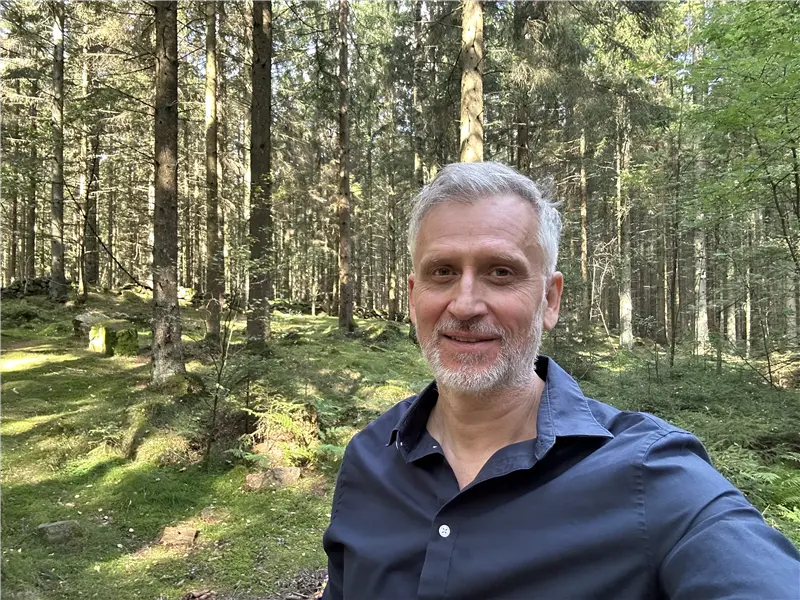
Per Löfberg
Per Löfberg is not an academic who observes the world from a distance. He has lived in it.
He has built a pellet factory in Zambia and led electric road projects in Sweden. He has sat in boardrooms in The Hague and shared tea with monks in Lusaka who laughed at their own uncertainty about what Christianity had actually brought to Africa. He was a professional actor for over twenty years, with roles in award-winning films and television productions across Sweden, Norway, Germany, and the UK — and it's no accident that he knows how to carry a story and hold a room.
His education is just as restless as everything else: acting school in Vordingborg, intelligence service during military duty, a year in Santa Clara University's program for social entrepreneurship, two years at Moving Arts and Business in Copenhagen. Every stop taught him something he wouldn't otherwise have.
As co-founder of Emerging Cooking Solutions, the company behind SupaMoto, he has spent more than a decade working on real energy transition in one of the world's most demanding environments — and seen firsthand what it actually takes when technology meets everyday human life. As project manager for Evolution Road, a 128-million-kronor infrastructure project for electrifying heavy transport, he kept complex partnerships alive through one of Sweden's most ambitious energy projects. He's also a recipient of Design S, the Swedish Design Awards, for the Z-stove (together with Zenit Design), and of WWF's Climate Solver award in 2012.
What makes Per's voice unusual is the combination — and the fact that he's never stopped acting, in both senses of the word.
He is not a guru. He's someone who has followed an inner compass through chaos, setbacks, and detours — and arrived at a few insights he wants to share. That makes the talk something other than information. It makes it a conversation.
Who it's for
For organizations that want more than a good afternoon
Our Place on Earth suits conferences, staff days, and educational settings working with the energy transition, sustainability, or leadership — as well as other settings pursuing the same thing from a different angle.
- Length
- Around 40 minutes plus open conversation
- Language
- Swedish or English
- Format
- Conference, staff day, education, other by arrangement
- Fee
- Discussed in conversation
Book the talk
Let's start a conversation
Tell me briefly about the context — who's listening, when it's happening, and what you hope the day or evening will leave behind.
Per reads everything himself and usually replies within a few days.